HIGHLIGHTS OF CALIFORNIA COLLECTIONS
Stories from the Library
Looking to Learn
The Stories from the Library exhibition series celebrates The Huntington’s world-class library collections by presenting rare archival materials through new and unexpected thematic lenses. In this installment, Looking to Learn, visitors encounter rich visual and historical printed and manuscript materials that illustrate shifts in teaching methods in England and the United States.
Exhibition Highlights
Now through June 15, 2026
📚
Tablas para los niños que empiezan a contar
The first schoolbook printed in California (1836) and other lesson books
🎨
Richly Illustrated Wall Charts
Visual teaching aids from the 18th & 19th centuries
🎲
Educational Board Games
Learning through play and hands-on activities
The exhibition explores:
- How changing ideas about child development inspired new teaching methods
- The incorporation of hands-on activities and practical subjects into learning
- Evolving viewpoints on childhood, morality, and intellectual curiosity
- The role of play in education across cultures and centuries
View our featured volume in person as part of the exhibition, Looking to Learn, which is open at The Huntington now through June 15, 2026.
The Story Continues
This month’s feature—a rare 19-page mathematics primer from 1836—offers an intimate window into early California’s educational landscape. Each weathered leaf whispers of teachers nurturing young minds, parents equipping children for hopeful futures, and students grasping essential knowledge of their world. Nearly two centuries later, we recognize ourselves in them.
Whose small hands turned these fragile pages when they were newly printed? What eyes studied these words and figures, absorbing lessons to last a lifetime? History guards these secrets, yet the book itself reveals something profound: knowledge vital to children nearly two centuries ago remains vital to our children still. Just as their futures form our past, so too, our own future will become the foundation of generations yet to come.
And the story continues…
These pages are samples from the 19-page textbook.
Click The Huntington button
to review all the pages in the digital library.
HIGHLIGHTS OF CALIFORNIA COLLECTIONS
California's First Textbook
Tablas Para Los Niños Que Empiezan A Contar
MONTERREY, 1836 | IMPRENTA DE A. ZAMORANO
Discover the remarkable story of the first textbook published in what would
become California—a mathematical primer that taught children in Spanish
colonial territory the fundamentals of counting, time, and currency.
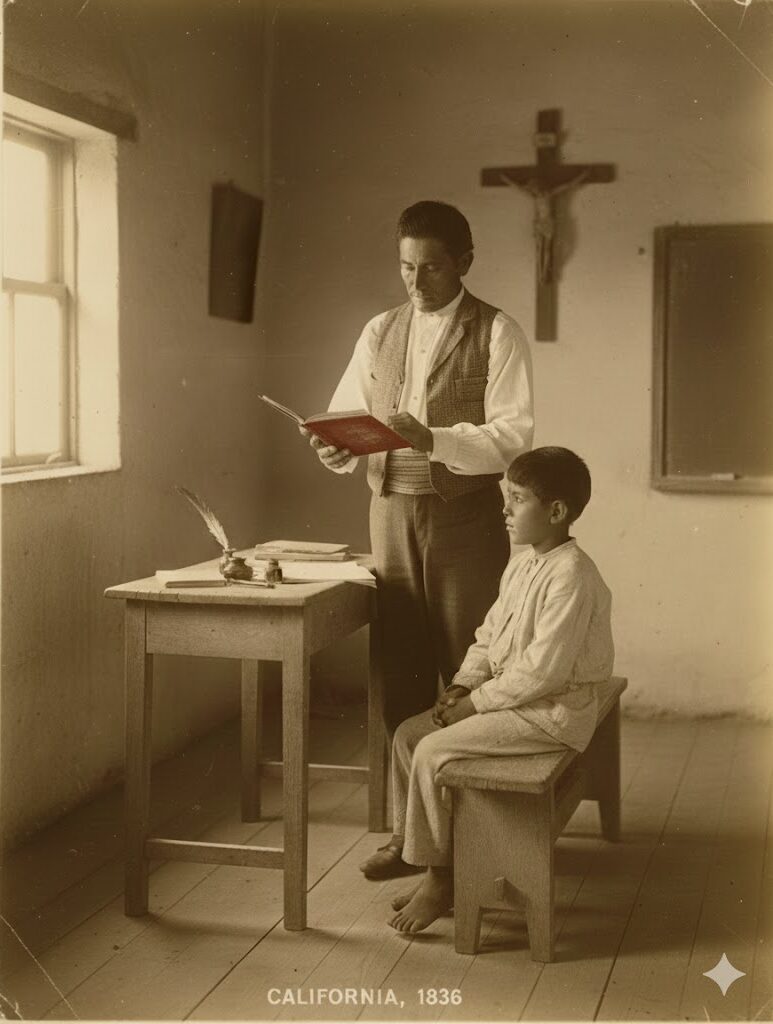
A Glimpse into 1836
Imagine a young student in Mexican California, learning mathematics from this precious textbook. In an era when books were rare and education was a privilege, Tablas Para Los Niños represented hope and opportunity for children beginning their journey with numbers.
This illustration captures the essence of how this textbook might have been used in a modest classroom or home in Monterrey, the capital of Alta California.
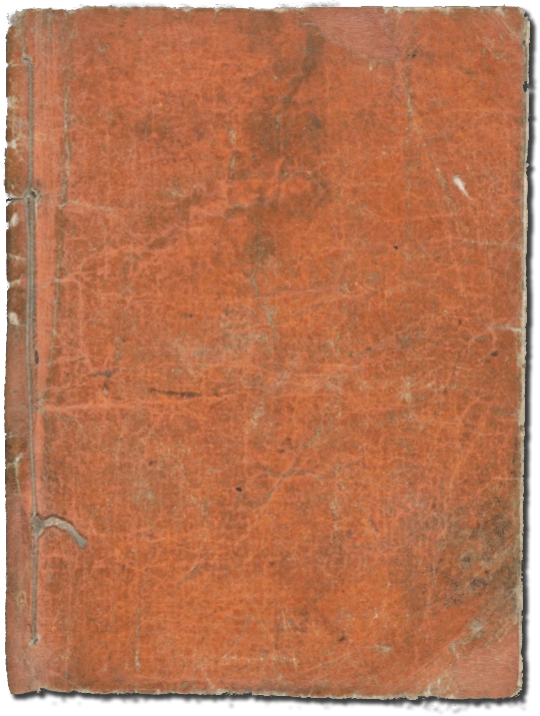
The Cover That Started It All
The worn, weathered cover tells its own story. This simple textbook, Tables for Children Who Are Beginning to Count, was published by A. Zamorano’s press in Monterrey in 1836—making it a cornerstone of California’s educational heritage.
From behind this scarred cover, a young voice echos to us across nearly two centuries of history.
Original Spanish:“Soy del simple huso de…(original name crossed out)”
English Translation:“I am the simple property of…” The book was signed by Pedro Castro near the front and Monterrey (Alta California) is written in the back.

A Personal Touch
The inside front cover reveals the book’s owner—”Pedro Castro”—his stylish name apparently replacing that of a previous owner. These personal markings transform the textbook into a window into the life of an actual student from nearly 200 years ago.
Handwritten notes inside include:
“Monterrey Octobre 13 de 1836” – a place and date along with practice arithmetic calculations and notes showing the book’s continued use.
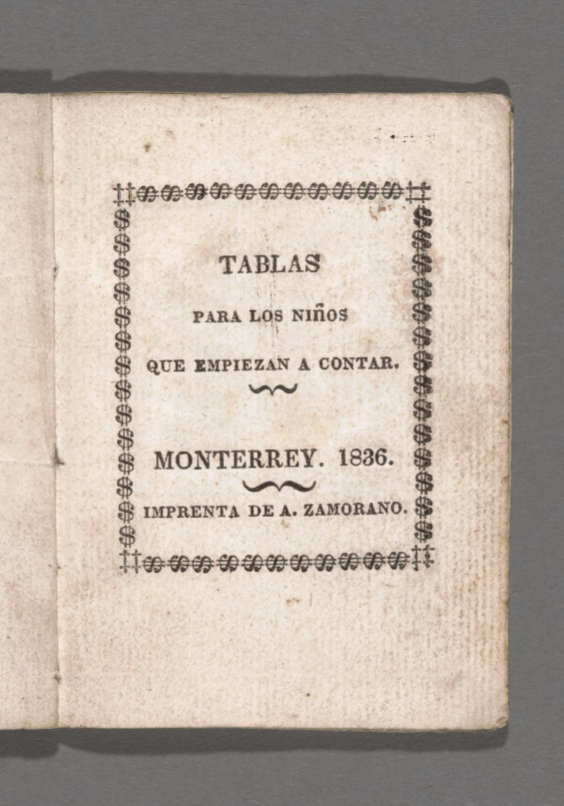
The Official Title Page
Printed with elegant typography and decorative borders, the title page announces: “TABLAS PARA LOS NIÑOS QUE EMPIEZAN A CONTAR” (Tables for Children Who Are Beginning to Count). Published in Monterrey, 1836, by Imprenta de A. Zamorano.
Historical Note:
Agustín Vicente Zamorano operated one of California’s first printing presses, making this book a testament to early publishing efforts in the region.
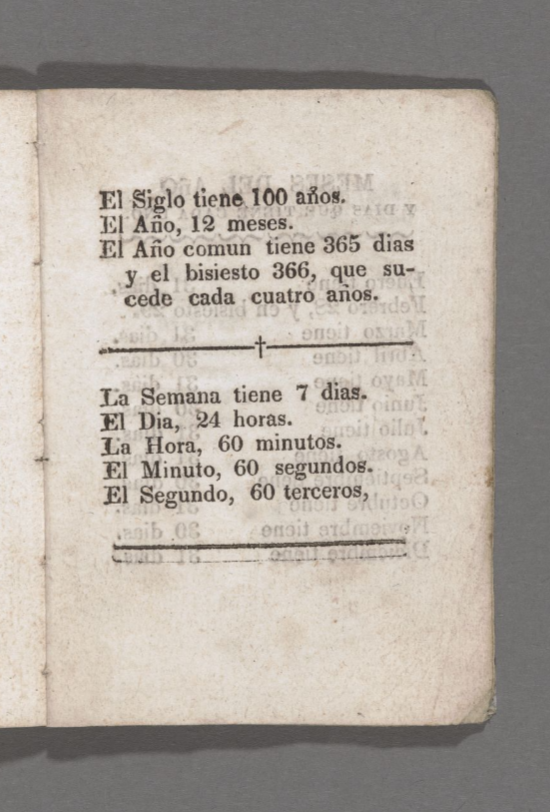
Understanding Time
This page teaches fundamental concepts of time measurement, from the century down to the second. Notice the inclusion of leap year information—practical knowledge for young mathematicians.
Translation:
• El Siglo tiene 100 años (The Century has 100 years)
• El Año, 12 meses (The Year, 12 months)
• La Semana tiene 7 días (The week has 7 days)
• El Día, 24 horas (The day, 24 hours)
• La Hora, 60 minutos (The hour, 60 minutes)
• El Minuto, 60 segundos (The minute, 60 seconds)
• El Segundo, 60 terceros (The second, 60 thirds)
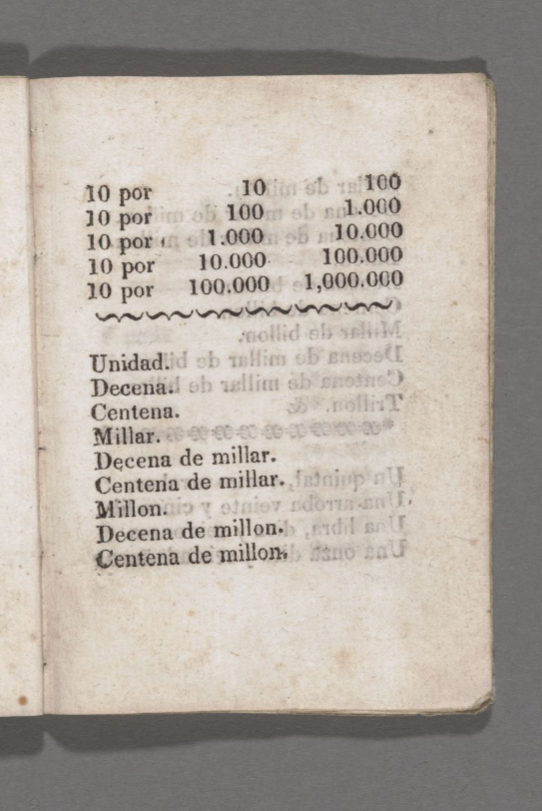
The Building Blocks of Mathematics
Before tackling complex calculations, students learned the decimal system through clear, progressive tables showing multiplication by 10. This page then demonstrates place values from Unidad (ones) through Centena de millón (hundred millions).
Educational Note:
The systematic approach mirrors modern teaching methods, showing that effective pedagogy transcends time and place.
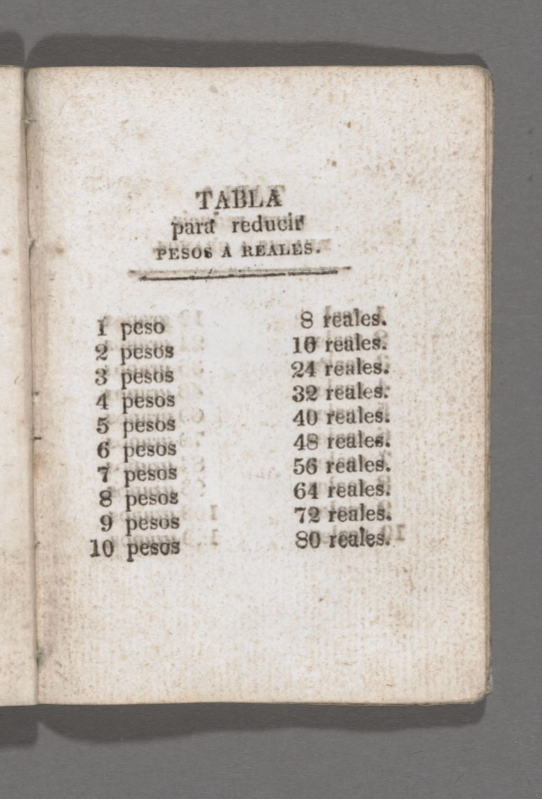
Money Matters in Mexican California
Practical mathematics met daily life in this currency conversion table. Students learned to convert Mexican pesos to Spanish reales—essential knowledge in a territory where commerce connected Spanish colonial tradition with Mexican governance.
Translation:
“TABLA para reducir PESOS A REALES”
“Table to Convert Pesos to Reales”
Conversion Rate: 1 peso = 8 reales
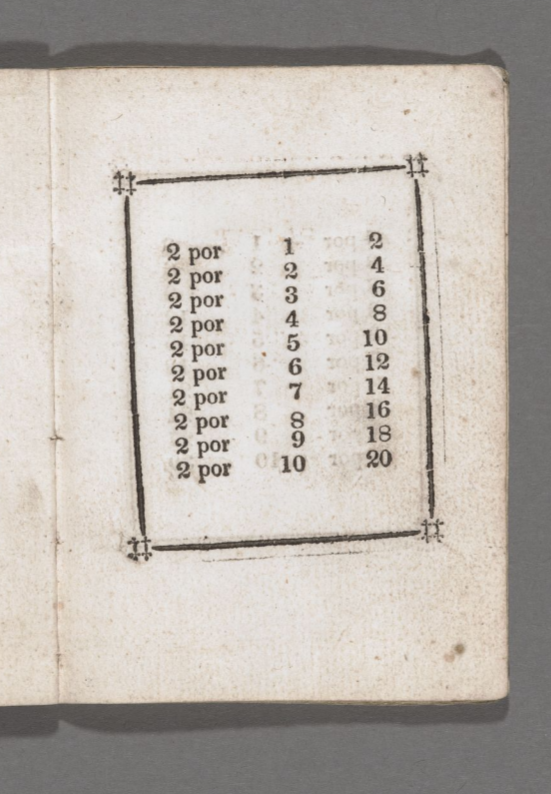
Learning Through Repetition
The heart of mathematical education: multiplication tables. This page shows the 2-times table in a decorative bordered frame, demonstrating how even basic drills were presented with aesthetic consideration.
Pedagogical Approach:
The use of decorative borders around educational content shows attention to making learning materials visually appealing to young students.
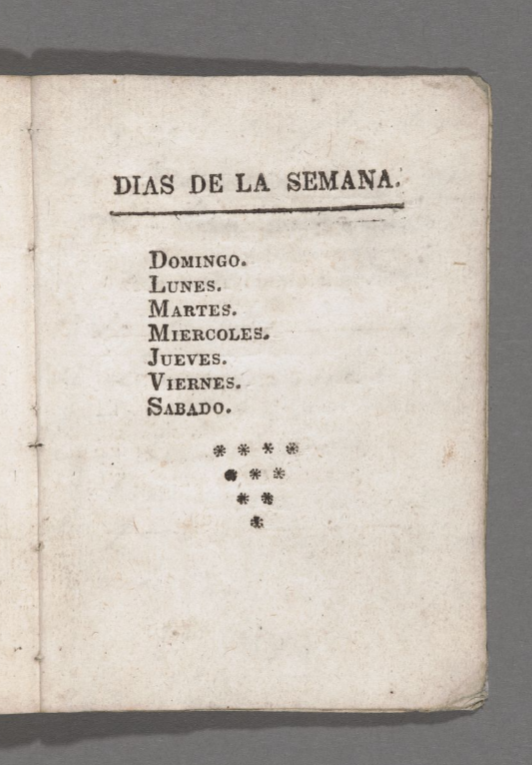
Organizing Time
Every student needed to know the days of the week. This elegant page lists them in Spanish: Domingo through Sábado, with decorative asterisks adding visual interest to the lesson.
Days of the Week:
• Domingo (Sunday)
• Lunes (Monday)
• Martes (Tuesday)
• Miércoles (Wednesday)
• Jueves (Thursday)
• Viernes (Friday)
• Sábado (Saturday)
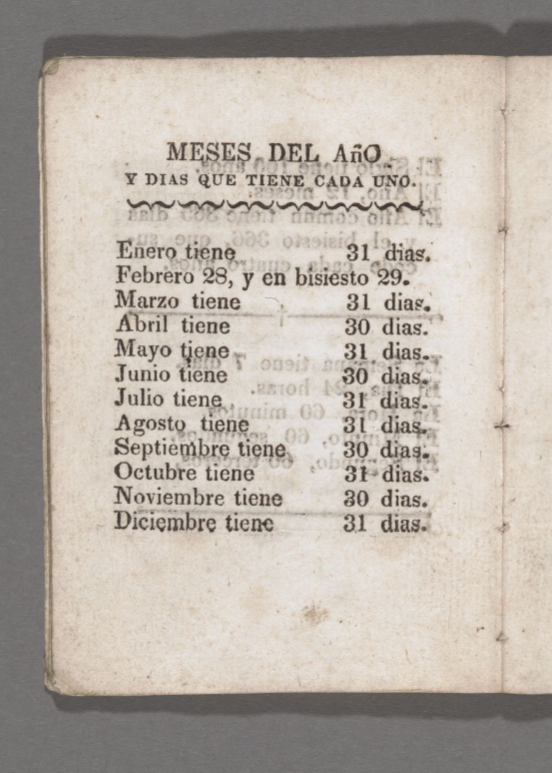
The Calendar Explained
This comprehensive page teaches the months of the year and their respective day counts, including the special note about February’s 28 days (29 in leap years). Practical information every educated person needed to know.
Translation:
• Enero tiene 31 dias (January has 31 days)…
• Diciembre tiene 31 dias (December has 31 days)
• Special note: “Febrero 28, y en bisiesto 29” (February 28, and in leap year 29)
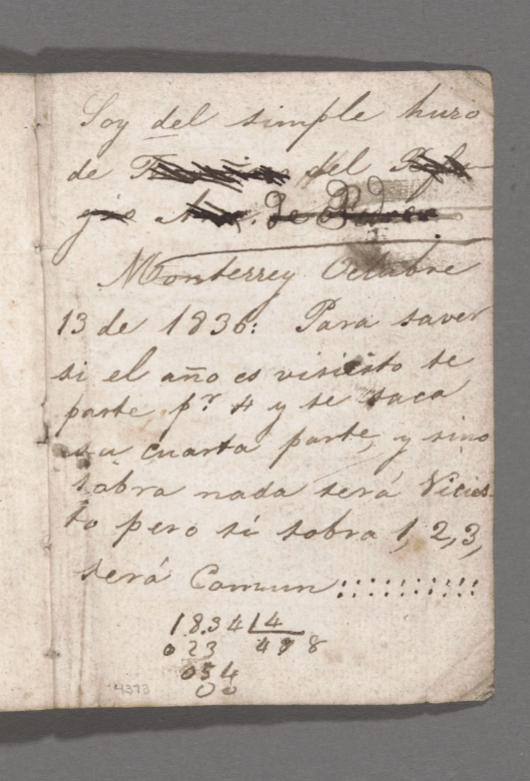
Whispers From the Past
The legible writing on this final page begins with a reference to Monterey, Alta California (Monterey, California today) using an alternate double-r spelling common in mid 1800s Spanish. After the date, October 13th of 1836, the author goes on to describe how to determine if a given year is a leap year using mathematics.
Reflection:
This textbook represents not just educational history, but the aspirations of families in Mexican California who valued learning and sought to give their children the gift of knowledge.
This slender volume represents but one treasure among thousands—documents, letters, ledgers, manuscripts—chronicling California’s journey from Spanish colony through Mexican territory to American statehood. Each artifact preserves voices that would otherwise be lost to us.
Scholar or genealogist, history enthusiast or curious soul—the collections at The Huntington await your exploration. Discover what treasures lie waiting in the extensive holdings of California’s documentary past. The button transports you to The Huntington’s Digital Collection where many more treasures may be found.