ARCHIVAL COLLECTION · HAROLD N. OUYE
A Life Framed
in Color & Time
Home movies, photographs, and memories of Sacramento’s Japantown — before it disappeared forever
1940s — 1960s · Sacramento, California
Ouye’s Pharmacy, 4th & L St., Sacramento · ca. 1955
"He documented the world that was about to vanish — streets, storefronts, neighbors, a community's heartbeat — in vivid color, at a time when most saw only black and white."
HAROLD N. OUYE COLLECTION · CENTER FOR SACRAMENTO HISTORY
The Story
A Pharmacist Who Became an Accidental Archivist
Harold N. Ouye was born Merch 13, 1907 in Florin, California, to Japanese immigrants who worked the orchards and fields of the Central Valley. His journey took him from the farmlands to the University of California, where he earned his pharmacy degree, and eventually to Sacramento’s vibrant West End and Japantown.
He opened Ouye’s Pharmacy at 4th and L streets with his brother Fred — a neighborhood institution that served the community for decades. But Harold carried something else too: a camera and color film, rare tools for documenting ordinary life in an era before anyone called it preservation.
His footage and photographs capture a Sacramento that no longer exists — demolished during the sweeping redevelopment of the 1950s and 60s that erased Japantown from the map. What he left behind is irreplaceable: a view from inside a community that survived incarceration, rebuilt itself, and then watched its streets vanish.
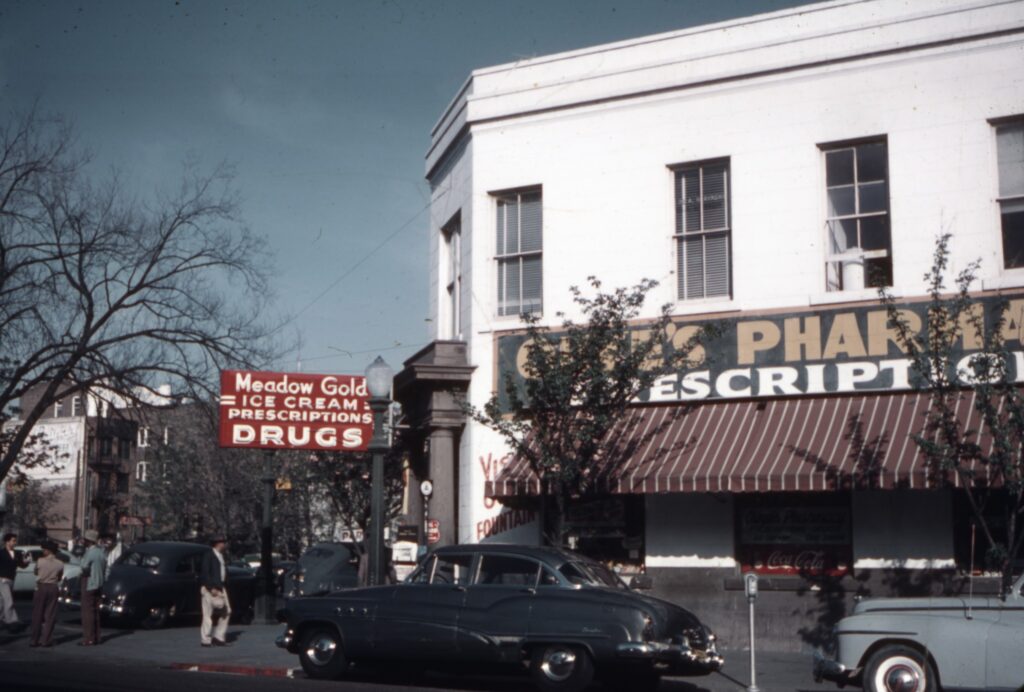
Ouye’s Pharmacy, 4th & L St. · ca. 1955
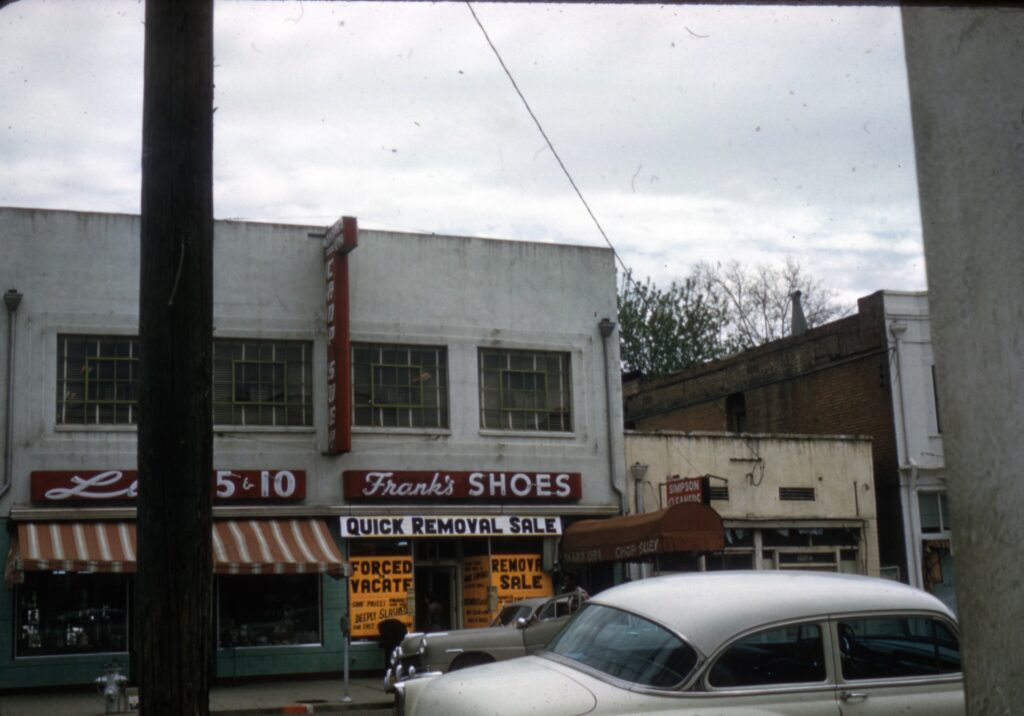
Frank’s Shoes — Forced Vacate Sale · 4th St., 1958
A LIFE IN TIME
The Chronicle of Harold Ouye
1907
Born in Florin, California to
Kenichi and Sada Ouye, Japanese immigrants from Hiroshima
who farmed the land of the Central Valley.
1930s
Graduated from the University of California, San Francisco
with a pharmacy degree. Worked in Stockton and Fresno before settling in Sacramento. Married Grace; together they had three children.
1930s
Opened Nippon Drugs at 3rd and L
streets in Sacramento's bustling Japantown — a cornerstone of the community.
1942
Executive Order 9066. The Ouyes, along with 120,000 Japanese Americans,
were forcibly incarcerated. Harold and his family were sent to the Tule Lake War Relocation Center.
1947
After release, Harold and his brother Fred reopened their pharmacy as Ouye's Pharmacy
at 4th and L streets. The community rebuilt, and so did they.
1940s–60s
Harold documented Sacramento's West End and Japantown
in color film and photographs — capturing the streets, people, and places that would soon be demolished.
1959
Japantown demolished. Redevelopment forced the pharmacy to relocate to 10th and V streets. Block by block, the neighborhood Harold had filmed disappeared.
1977–2007
Harold and Fred retired in 1977. Harold's son, Lloyd, carried on
the pharmacy for another three decades, until it closed in 2007 — ending sixty years of family service.
1991
Harold N. Ouye passed away August 21, 1991, in Sacramento.
His collection of films and photographs endures as testament to a community's resilience and humanity.
Explore the Archive
Access Harold Ouye's
Living Legacy
01 / FINDING AID
Online Archive of California
The complete finding aid for the Harold N. Ouye collection, documenting every film reel and photograph in detail.
02 / FILM ARCHIVE
Digitized Home Movies
Watch Harold’s digitized color home movies on the Center’s Internet Archive page — Sacramento in motion, in living color.
03 / ORAL HISTORY
Harold Ouye in His Own Words
An oral history interview with Harold Ouye, recorded as part of the Issei Oral History Project. Hear his story directly.
The Full Report
The complete report from the Center for Sacramento History
The Center for Sacramento History’s Harold N. Ouye collection contains color film footage and color photographic slides documenting Harold Ouye and his family and Sacramento’s West End and Japantown before, during, and after redevelopment from the 1940s until the 1960s.
Harold N. Ouye was born March 13, 1907, in Florin to Kenichi and Sada Ouye, Japanese immigrants from Hiroshima who worked as fruit farmers. The Ouyes had five other children: Fred, Carnegie, Norman, Alice, and Raymond (who died in infancy). The family moved to Lodi when Ouye was a child. He attended University of California, San Francisco, graduating with a pharmacy degree. After graduation, Harold worked as a pharmacist in Stockton and Fresno, then moved to Sacramento where he opened Nippon Drugs at 3rd and L streets. Ouye and his wife, Grace, were married in the early 1930s and they had three children: Sandra Mori, Gail Yoshioka, and Lloyd Ouye.
In 1942, the United States issued Executive Order 9066 calling for the removal and incarceration of people of Japanese descent into internment camps. The Ouyes were incarcerated at Tule Lake War Relocation Center. After their release, Ouye and his brother Fred opened Ouye’s Pharmacy at 4th and L streets in 1947. The store moved to 10th and V streets in 1959 after Sacramento’s Japantown was demolished during redevelopment. The brothers retired in 1977, after which Harold’s son Lloyd took over the business. It closed in 2007.
Ouye was a founder of the South Tanoshimi Kai senior program at the Sacramento Japanese Methodist Church and was a member of the Sacramento Japanese American Citizens League. He died August 21, 1991, in Sacramento.
The Harold N. Ouye collection finding aid is accessible through the Online Archive of California and many of the home movies are digitized and on the Center’s Internet Archive page. An oral history interview with Harold Ouye was done as part of the Issei Oral History Project and is in collection MS0173 at the Center for Sacramento History. It is digitized and available on the Center’s Internet Archive page. The Center also has a page on their website of Japanese American research resources, documenting the Japanese community in Sacramento.